
Home/Solutions/AI governance
For the AI governance lead
Know every AI system you run, and govern it in proportion.
Discovery-first AI governance: an inventory built from what is actually in use, risk tiering, impact assessments, human oversight, vendor AI clauses and ISO/IEC 42001 readiness, on the same record as the rest of your controls.
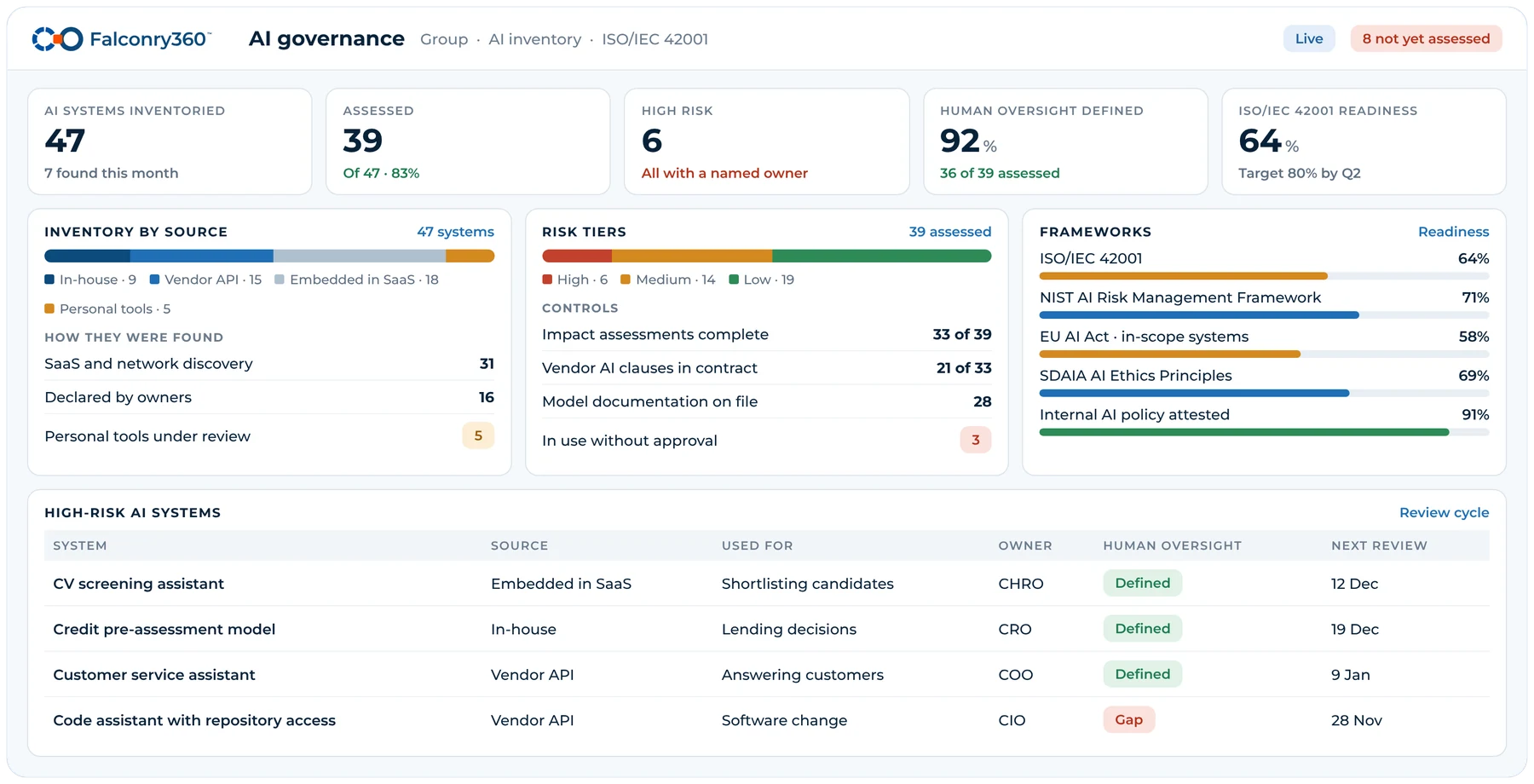
Nothing invisible
An inventory built from SaaS, network and procurement data as well as what owners declare.
Oversight in proportion
High-risk systems get human oversight first; low-risk tools are not buried in process.
Ready for 42001
Management-system evidence builds as you govern, so certification is a choice, not a project.
How it automates
Watch it run.
Each step happens on the same record, so the next one starts where the last one finished.
Step 1 · Discover
- The AI Inventory agent read SaaS, network and procurement data
- 31 systems found, 16 declared, 47 in total
- Draft inventory entries sent to each owner to confirm
Step 2 · Classify
- 39 systems tiered against your AI policy
- 8 systems waiting for owner confirmation
- High-risk systems routed for impact assessment
Step 3 · Assess
- Impact assessment drafted for the CV screening assistant
- Owner and AI governance lead reviewed and approved it
- Vendor contract gap flagged for procurement
Step 4 · Oversee
- Code assistant with repository access: oversight gap raised to the CIO
- 3 unapproved tools moved to review
- AI acceptable use attested by 91% of staff
Step 5 · Assure
- Management-system evidence mapped to ISO/IEC 42001
- Readiness gap list issued with owners
- AI risk added to the Board trust report
What runs on Falconry360
Everything AI governance needs, in one place.
AI inventory and discovery
Systems found from SaaS, network and procurement data, confirmed by their owners.
Risk tiering
Impact-based tiers aligned to your policy and the regimes that reach you.
Impact assessments
Pre-filled from the record, decided by the owner and the AI governance lead.
Human oversight
Who decides, who can override and what is logged, defined per high-risk system.
Vendor and embedded AI
AI added to products you already use, flagged against contracts and the inventory.
ISO/IEC 42001 management system
Policy, objectives, roles, risk and internal audit evidence for an AI management system.
FalconryX agents on this work
The legwork, done. The judgement, yours.
Every agent output shows its sources and goes to a named reviewer before it counts.
- AI Inventory
- Third-Party
- Evidence
- Policy
- Regulatory Change
Standards
- ISO/IEC 42001:2023
- ISO/IEC 23894
- NIST AI Risk Management Framework
Regulation and principles
- EU AI Act
- SDAIA AI Ethics Principles
- UAE Charter for the Development and Use of AI
- Oman MTCIT Public Policy for the Safe and Ethical Use of AI Systems
- UK AI regulation principles
- Colorado AI Act
Run it your way
Platform, people, or both.
Client-led
Your team runs it on Falconry360, with our content, libraries and support.
Co-managed
We run the heavy lifting; your team owns decisions and the relationship with the business.
Fully managed
Our specialists run it end to end inside your tenant, reporting to your CISO, DPO or risk committee.
Questions
What people ask first.
Where do we start?
With the inventory, not the policy. You cannot govern what you cannot list, and discovery usually finds more than anyone expected.
Does this cover the AI inside software we buy?
Yes. Embedded and vendor AI is inventoried alongside in-house models, with contract clauses tracked through third-party risk.
Do we have to certify to ISO/IEC 42001?
No. The management-system structure is useful on its own; certification becomes an option rather than a separate project.
See AI governance on your own perimeter.
A thirty-minute working session with your team, mapped to the regulators you answer to.