
Pillar 4 of 5 · Resilience and response
Keep the services your customers depend on within tolerance.
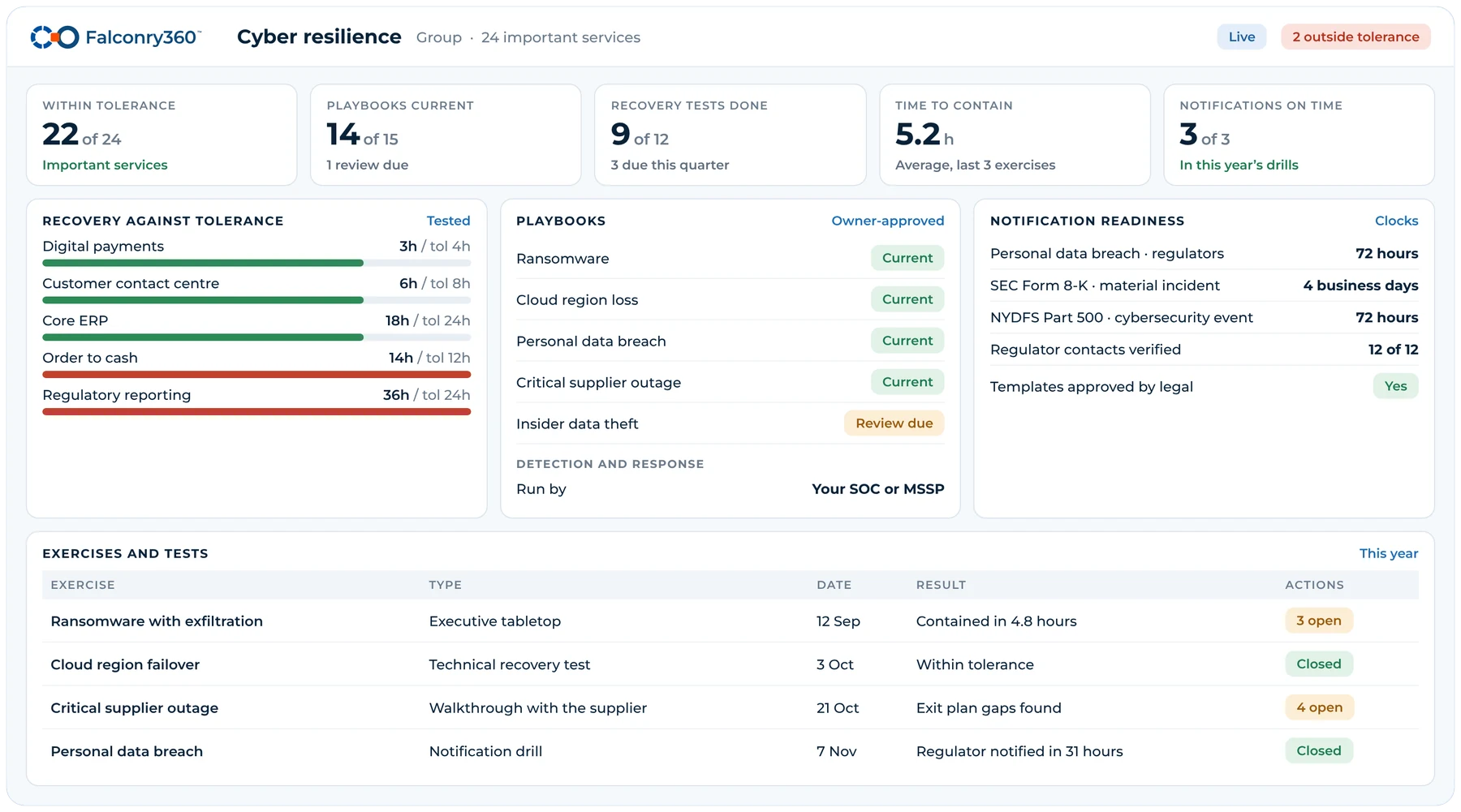
Withstand connects important services, impact tolerances, dependencies, continuity plans, incident playbooks and scenario tests, so resilience is measured by the customer impact that matters.
The role lens
One record, read differently by each seat.
Know what the service depends on
Map applications, infrastructure, people, facilities, cloud and suppliers to the services the organisation must keep running.
Connect cyber incidents to operational impact
Use the same scenario library, incident record and control history to prioritise response, recovery and investment.
Be ready for the data consequence
Keep data locations, processors, notification clocks and decision paths visible when a disruption becomes a privacy event.
Test the tolerance, not the document
See which services are outside tolerance, what was exercised, what failed and whether the remediation was verified.
Components
What Withstand runs on Falconry360.
Each component is a configured module in your tenant, with owners, workflows, evidence requirements and reporting.
Important services and tolerances
Services identified from the customer and market point of view, with approved maximum tolerable disruption.
Dependency mapping
People, applications, data, infrastructure, facilities, suppliers and fourth parties mapped against the same masters.
Business impact and continuity plans
Impact analyses, strategies and plans, with review currency tracked against the continuity cycle.
IT service continuity and recovery
Recovery capability, failover, objectives, tests and supplier commitments per important service.
Incident and crisis management
Playbooks, roles, decision logs and notification clocks across every regime in scope.
Scenario exercising
Severe-but-plausible exercises with the right decision-makers, and the actions they produce tracked to closure.
From record to routine
How the work runs, week after week.
- Define the serviceAgree what matters, who owns it and how much disruption is acceptable.
- Map dependenciesConnect the service to the assets, people, suppliers and data that support it.
- Run the scenarioExercise a severe-but-plausible disruption with the right decision-makers in the room.
- Capture the decisionRecord what happened, what was outside tolerance and which action changes the outcome.
- Verify recoveryRe-test until the service holds inside tolerance, and keep the evidence.
Connected by design
Withstand gives the other pillars their signal.
Every record carries scope, authority, dates, status and evidence, so a change in one pillar shows up where it matters in the others. Select a connection.
An exercise result updates the likelihood and magnitude in the Anticipate scenario.
Explore AnticipateFalconryX in Withstand
Faster preparation. Human decisions.
FalconryX drafts and flags from approved records. A named person reviews and approves what becomes official.
Design a severe-but-plausible scenario
Use the service, dependency map, risk record and prior exercise results to propose a focused scenario and objectives.
Prepare role-based exercise injects
Draft timed injects for executive, technology, privacy, communications and supplier teams against the approved design.
Organise the live event record
Compile approved updates into a timeline, flag decision and notification clocks and prompt the accountable team.
Draft lessons and remediation
Draft the post-incident review from the timeline and point to the dependencies and controls the event actually tested.
Regulatory and standards anchors
Start with the instruments you answer to.
Coverage is indicative until your perimeter is confirmed. The applicable pack, mapping and ownership are agreed during scoping and maintained as instruments change.
- ISO 22301
- SAMA BCM Framework
- CBUAE business continuity requirements
- NIST CSF 2.0 · Respond and Recover
- UK NCSC CAF · Objectives C and D
- FCA and PRA operational resilience
- DORA
- NCEMA 7000
Test the service that cannot fail.
Bring one important service, tolerance or scenario. We will show the dependency map, the workflow and the evidence path.